Sarajevo, the busiest term before the final exams, the term where everything was due, the battleground of one of the most recent wars fought on European soil, the most culturally diverse place I have ever visited, a place that has much m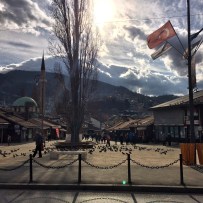 ore to offer than its history and the way it is presented in the media. Going into the term, I did not think too much about Sarajevo as a city or Bosnia as a country. I knew about its history, and I knew about the current state of the country. However, my mind was focused more on the fact of staying on top of my workload, which has already dominated my winter break prior. Nevertheless, as soon as I arrived the
sheer presence of the history and the historical significance of the place struck me on the spot. The view out of my room looked straight at rows of apartment blocks with huge massive but closed mortar/bullet holes in its walls. Additionally, the majority of the bullet holes are still very visible in the buildings all around the city. Although it is not part of my History curriculum, I became so 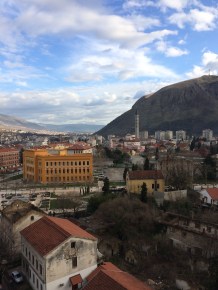 curious that I started wondering around, looking for the significant places in my free-time. The one that stuck out for me was encountered spontaneously. I went to pick up a parcel from the parcel office, a little bit outside of the city. On our way there a friend and I encountered something that looked the ruins of a bombarded building. Therefore, we
decided to explore it on the way back. Thus, we picked up the parcel and went back to the building. It was located along an abandoned road. We started wondering around and climbing onto the debris to peak at the extent of the impact the, most likely, bomb had on the inside of the building. The extent was horrendous and very daunting to see and imagine what it would have been like to be there at the time it happened. It seemed like no one has been there in a long time. This was confirmed by what happened after we approached the end of the road alongside the building. We suddenly heard and 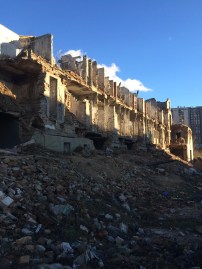 saw three street dogs barking fiercely at us, from a distance of approximately 25 meters. Looking at each other, we both knew that we should stay calm and slowly walk away and definitely not run, as this would make the dogs chasing us even more likely. However, as soon as we looked back at the dogs, they started taking off and chasing us, out of the blue. I think I have never run that fast as I did that day. Yet, one of the medium sized dogs managed to come as close as 2-3 meters. I was ready to swing my backpack around to catch the dog mid-air if he came any closer and decided to jump and try to bite me. Through some miracle, the dog stopped, and we could escape. This was the biggest adrenaline rush I have ever experienced but hope never ever to do again.
On the flipside, the people I met in Sarajevo were not at all, as their history and country would suggest, hostile or unfriendly. Every person I met, was welcoming and very helpful if I had any questions. Additionally, although the war is still so present, I did not notice any hostility amongst the different ethnic groups, although it was told us that there still was some.
In conclusion, the stigma around Bosnia and Herzegovina is entirely false; it is not the war-torn country or the aftermath of communist rule, no, in my opinion, it is a beautiful and very diverse country that is thriving for a better and peaceful future.
 Joshua Buse